Traders’ Glossary™
Use the “Find” command in your browser window to go directly to any key word.
- %D
- A stochastics indicator that has had its values smoothed a second time, usually with a three-period moving average.
- Daily Range
- The difference between the high and low price during one trading day.
- Data Preprocessing
- Altering data to some extent to be more accurately analyzed; smoothing, reducing unwanted data, removing trend. Processing data is mathematically transforming the data from one form into another with the goal of amplifying pertinent information for traders.
- Dead Cat Bounce
- A rebound in a market that sees prices recover and come back up somewhat.
- Debit Spread
- The difference in value of two options, where the value of the long position exceeds the value of the short position.
- Deductive Logic
- Logic traditionally used in expert systems, which defines a method for reasoning from the general to the specific.
- Deep-in-the-Money
- A deep-in-the-money call option has the strike price of the option well below the current price of the underlying instrument. A deep-in-the-money put option has the strike price of the option well above the current price of the underlying instrument.
- Degrees of Freedom
- The number of independent observations; the number of observations minus the number of parameters to be estimated.
- Delay
- The amount of time that elapses between a change in an input event and the resultant change in a related output event or time series.
- Delta
- The amount by which the price of an option changes for every dollar move in the underlying instrument.
- Delta-Hedged
- An options strategy that protects an option against small price changes in the option’s underlying instrument. These hedges are constructed by taking a position in the underlying instrument that is equal in magni tude but opposite in sign (+/-) to the option’s delta.
- Delta Neutral
- This is an "options/options" or "options/underlying instrument" position constructed so that it is rela tively insensitive to the price movement of the underlying instruments. This is arranged by selecting a calculated ratio of offsetting short and long positions.
- Delta Position
- A measure of option price vs. the underlying futures contract or stock price.
- Demand Index
- An index that shows the buying and selling power of markets and stocks from mathematical calcu lations of volume and price ratios.
- Density Function
- For any measure m , a function that gives rise to m when integrated with respect to some other specified measure. A probability density function is a function whose integral over any set gives the probability that a random variable has values in this set.
- Dependence
- A relationship between two different experimental results in which the first result does not directly influence the chances of the second result occurring, but instead, the two results are indirectly related because they are subject to influences from a common outside factor.
- Derivatives
- Financial contracts the value of which depend on the value of the underlying instrument commodity, bond, equity, currency or a combination.
- Deterministic
- Known in advance when the sum of one-step ahead forecast mean squared errors is zero.
- Deterministic
- The fundamental continuous effect of an exogenous variable such as money supply that can be deter mined to be explanatory.
- Deterministic System
- A system in which the outcome is determined by an equation; a system in which cause and effect is easily determined.
- Detrend
- To remove the general drift, tendency, or bent of a set of statistical data as related to time.
- Difference-in-Means Test
- A statistical test that indicates the likelihood of observing the difference if the true differ ence were zero. A large value of this statistic leads to nonacceptance of the null hypothesis that the true difference is zero.
- Differencing
- Subtracting previous from current values to obtain a stationary (detrended) time series: P stationary = Pt - Pt-1.
- Diffusion Equation
- A partial differential equation, used in solving a random walk problem.
- Diffusion Index
- An index that measures the percentage of individual series that are positive compared with the aggregate group that is, the percentage of S&P groups that are above their 30-week moving average.
- Directional Movement Index (DMI)
- Developed by J. Welles Wilder, DMI measures market trend.
- Distribution
- Any set of related values described by an average (that is, mean), which identifies its midpoint, a measure of spread (that is, standard distribution) and a measure of its shape (that is, skew or kurtosis).
- Divergence
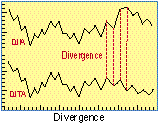
When two or more averages or indices fail to show confirming trends.- Dividend
- Stockholder payment of a share of a company’s profits.
- Dividend Reinvestment Plan
- A program offered by a publicly held company in which dividends are used to buy more shares of the company.
- Doji
- A session in which the open and close are the same (or almost the same). Different varieties of doji lines (such as a gravestone or long-legged doji) depend on where the opening and close are in relation to the entire range. Doji lines are among the most important individual candlestick lines. They are also components of important candlestick patterns.
- Dollar Cost Averaging
- Using the same amount of funds to regularly invest (often quarterly or monthly) and not take into consideration whether the securities being purchased are high or low in price. By using this method, an investor will see an average between their investment costs and the market’s up and down movements.
- Double Bottom (Top)
- The price action of a security or market average where it has declined (advanced) two times to the same approximate level, indicating the existence of a support (resistance) level and a possibility that the down ward (upward) trend has ended.
- Double-Smoothed
- A price series that has been smoothed by a mathematical technique such as a moving average. This first series of smoothed price data is then smoothed a second time.
- Double Top
- See Double Bottom. A price pattern seen on a chart. The patterns occurs when prices rise to a resistance level on significant volume, retreat to a support level, and subsequently return to the resistance level on decreased volume. Prices then decline and break through the support level, marking the beginning of a new downtrend in the price of the stock.
- Drawdown
- The reduction in account equity as a result of a trade or series of trades.
- Drunkard’s Walk
- See Random walk.
- Durbin-Watson Statistic
- The probability that first order correlation exists. With a range between zero and 4, the closer to 2.0, the lower the probability is.
- Dynamic Data Exchange
- Ability to automatically update an application from within another application.
- Dynamic Linked Language
- Refers to programming code that can be used ("called") by your main program while running under Windows.
- Early Entry
- A large price movement in one direction within the first 15 minutes after the open of the daily session.
- Earnings Estimates
- The estimated earnings projected for a company for a fiscal year.
- Efficient Market Theory
- All known information is already discounted by the market and reflected in the price due to market participants acting upon the information.
- Elasticity
- The ability to recover an original configuration.
- Electronic Communications Network
- Independent execution systems set up by brokerage firms, matching new retail limit orders with compatible orders already in the system.
- Elliott Wave Theory
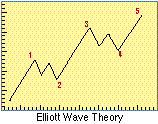
A pattern-recognition technique published by Ralph Nelson Elliott in 1939, which holds that the stock market follows a rhythm or pattern of five waves up and three waves down to form a complete cycle of eight waves. The three waves down are referred to as a "correction" of the preceding five waves up.- EMA
- See Exponential Moving Average.
- Engulfing Pattern
- In candlestick terminology, a multiple candlestick line pattern; a major reversal signal with two opposing-color real bodies making up the pattern. (Also referred to as tsutsumi. )
- Envelope
- Lines surrounding an index or indicator that is, trading bands.
- Entry
- The point at which a trader gets into a position in the market.
- Equilibrium Market
- A price region that represents a balance between demand and supply.
- Equivolume Chart
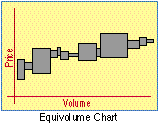
Created by Richard W. Arms, a chart in which the vertical axis is the high-low range for each day, while the horizontal axis represents the volume of shares of stock or the number of contracts traded for the day. The purpose of the chart is to highlight the relationship between price and volume.- ERISA
- The Employee Retirement Income Security Act.
- Estimated EPS Change
- (%) Change in estimated mean earnings for the current fiscal year from the last month, last three months and last six months to the current month.
- Eurodollar
- Dollars deposited in foreign banks, with the futures contract reflecting the rates offered between London branches of top US banks and foreign banks.
- Evening Star Pattern
- The bearish counterpart of the morning star pattern; a top reversal, it should be acted on if it arises after an uptrend.
- Exchange-Traded Funds
- Collections of stocks that are bought and sold as a package on an exchange, principally the American Stock Exchange (AMEX), but also the New York Stock Exchange (NYSE) and the Chicago Board Options Exchange (CBOE).
- Ex-Dividend Date
- The day on or after which the right to receive a current dividend is not automatically transferred to a buyer.
- Exercise
- The process by which the holder of an option makes or receives delivery of shares of the underlying secu rity.
- Exit
- The point at which a trader closes out of a trade.
- Expert Systems
- Dynamic but not adaptable, expert systems are rule-driven systems that cannot learn as the result of new information being fed into its system as opposed to neural networks, which can.
- Expiration
- The last day on which an option can be traded.
- Explained
- The relative reduction in the variation of variable Y that can be attributed to a knowledge of variable X and its relationship to Y.
- Exponential Moving Average
- The EMA for day D is calculated as:
 where PR is the price on day D and a (alpha) is a smoothing constant
  .
Alpha may be estimated as 2/(n+1), where n is the simple moving average
length. Another form of the formula is
.
Alpha may be estimated as 2/(n+1), where n is the simple moving average
length. Another form of the formula is  .
. - Exponential Smoothing
- A mathematical-statistical method of forecasting that assumes future price action is a weighted average of past periods; a mathematic series in which greater weight is given to more recent price action.
- Expert Systems
- Dynamic but not adaptable, expert systems are rule-driven systems that cannot learn as the result of new information being fed into its system as opposed to neural networks, which can. Most successful in financial applications where governing rules are consistent.
- Extreme
- The highest or lowest price during any time period, a price extreme; in the CBOT Market Profile, the highest/lowest prices the market tests during a trading day.
- F Statistics
- The ratio of the variance explained by treatments to the unexpected variance.
- Fade
- Selling a rising price or buying a falling price. A trader fading an up opening would be short, for example.
- Failure Swings
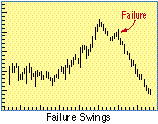
The inability of price to reaffirm a new high in an uptrend or a new low in a downtrend.- Failure
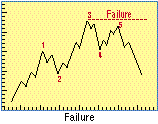
In Elliott wave theory, a five-wave pattern of movement in which the fifth impulse wave fails to move above the end of the third, or in which the fifth wave does not contain the five subwaves.- Fair Values
- The theoretical prices generated by an option pricing model (i.e. , the Black-Scholes option pricing model).
- Fast Fourier Transform
- A method by which to decompose data into a sum of sinusoids of varying cycle length, with each cycle being a fraction of a common fundamental cycle length.
- Fast Market
- A declaration that market conditions in the futures pit are so disorderly temporarily to the extent that floor brokers are not held responsible for the execution of orders.
- Federal Deposit Insurance Corporation
- A self-sustaining, independent executive agency established to insure deposits of all US banks entitled to federal deposit insurance, as stated by the Federal Reserve Act.
- Federal Reserve Bank
- The governing central bank of the US.
- Federal Open Market Committee
- The policymaking committee of the Federal Reserve Bank. They meet on a regular basis to make decisions on economic policy.
- Feedforward Computation
- Neural network in which neurons receive information only from the previous layer and send outputs only to the following layer.
- Fibonacci Ratio
- The ratio between any two successive numbers in the Fibonacci sequence, known as phi (f). The ratio of any number to the next higher number is approximately 0.618 (known as the Golden Mean or Golden Ratio), and to the lower number approximately 1.618 (the inverse of the Golden Mean), after the first four numbers of the series. The three important ratios the series provides are 0.618, 1.0 and 1.618.
- Fibonacci Sequence
- The sequence of numbers (0, 1, 2, 3, 5, 8, 13, 21, 34, 55, 89, 144, 233...), discovered by the Italian mathematician Leonardo de Pisa in the 13th century and the mathematical basis of the Elliott wave theory, where the first two terms of the sequence are 0 and 1 and each successive number in the sequence is the sum of the previous two numbers. Technically, it is a sequence and not a series.
- Fill
- An executed order; sometimes the term refers to the price at which an order is executed.
- Fill Order
- An order that must be filled immediately (or canceled).
- Filter Point
- The time at which a portfolio insurance program makes an adjusting trade.
- Filter
- A device or program that separates data, signal or information in accordance with specified criteria.
- Fire
- (verb) In expert system programming, ordinarily used to describe the "triggering" or "activation" of a rule. A rule is "fired," "triggered" or "activated" when its conditions have been met, and its "consequents" (resultant facts) are added to the knowledge base.
- Fit Criterion
- A quantitative comparable measure used to minimize model errors.
- 5% Confidence
- Before conducting statistical tests, an analyst must select a confidence level that will be used to determine when to accept the null hypothesis. A 5% confidence level indicates that one is not willing to accept the null hypothesis when the average net return calculated from the sample could have occurred in only five of 100 samples if the null hypothesis were true.
- Flaglike
- Sideways market price action that has a slight drift in price counter to the direction of the main trend; a consolidation phase.
- Flash Fill
- Order filled immediately by hand signal on the trading floor.
- Float
- The number of shares currently available for trading.
- Floor Traders
- Employees of brokerage firms working on exchange trading floors.
- Flyers
- Speculative or high-risk trades.
- Forecast Origin
- The most recent historical period for which data is used to build a forecasting model. The next time period is the first forecast period.
- Forward-Rate Agreements (FRAs)
- Cash payments are made daily as the spot rate varies above or below an agreed -upon forward rate and can be hedged with Eurodollar futures.
- Fractal Dimension
- From fractal geometry, used to describe the irregular nature of lines, curves, planes or volumes.
- Fractals
- Depiction of mathematical models that may be applied to identify data patterns.
- Framing or Frame Dependence
- Behavioral finance. The tendency to evaluate current decisions within the framework in which they have been presented. Making decisions based on perceptions of risk/return rather than pure risk and return. The usual example is categorization of where money comes from and what it is "assigned" to instead of recognizing its fungibility. The alternative is to speak of frame independence, wherein behavior is not influenced by how the decision is framed. Examples are loss aversion, hedonic editing, loss of self-control, regret, and money illusion.
- Frequency
- The number of complete cycles observed per time period (i.e., cycles per year).
- Frequency Component
- That part of a time series that may be represented as a cycle.
- Frequency Distribution
- A chart showing the number of times (or "frequency") an event occurs for each possible value of the event. The vertical or y-axis of the chart is the frequency axis and the horizontal or x-axis shows the different values the variable being measured can take.
- Frequency Domain
- Variation in a time series is accounted for by cyclical components at different frequencies.
- Frequency Response
- The transfer of the frequency of the underlying data, usually prices, to the frequency of its moving average.
- Front-Loaded
- Commission and fees taken out of investment capital before the money is put to work.
- Front Month
- The first expiration month in a series of months.
- Front-Running
- The practice of trading ahead of large orders to take advantage of favorable price movement. Brokers are prohibited from this practice.
- Fundamental Analysis
- The analytical method by which only the sales, earnings and the value of a given tradable’s assets may be considered.
- Fundamentals
- The theory that holds that stock market activity may be predicted by looking at the relative data and statistics of a stock as well as the management of the company in question and its earnings.
- Future Volatility
- A prediction of what volatility may be like in the future.
- Fuzzy Systems
- A problem-solving method that can be applied to neural networks, expert systems and other comput ing methods. Fuzzy systems process inexact information inexactly and describe ambiguity rather than the uncer tainty of an occurrence and are useful in performing control and decision-making tasks. Not Boolean.