Traders’ Glossary™
Use the “Find” command in your browser window to go directly to any key word.
- A Priori
- Known ahead of time.
- Abandoned Baby Pattern
- A rare candlestick pattern in which an upside gap doji star (where the shadows do not touch) is followed by a downside gap black candlestick where the shadows also do not touch; considered a major top reversal signal.
- ABC
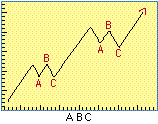
Elliott wave terminology for a three-wave countertrend price movement. Wave A is the first price wave against the trend of the market. Wave B is a corrective wave to Wave A. Wave C is the final price move to complete the countertrend price move. Elliott wave followers study A and C waves for price ratios based on numbers from the Fibonacci series.- Accumulation
- An addition to a trader’s original market position. The first of three distinct phases in a major trend in which investors are buying.
- Accumulation/Distribution Line
- See Chaikin Oscillator.
- Actuals
- Refers to actual physical commodities, as distinguished from futures.
- ADA
- Block-structured programming language developed under the guidance of the U.S. Department of Defense to provide a medium for writing real-time, concurrent applications, for facilitating program verification.
- Adaptive Filter
- Smoothing and/or forecasting prices with continuously updated weighting of past prices.
- Advance-Decline Line
- Each day’s number of declining issues is subtracted from the number of advancing issues. The net difference is added to a running sum if the difference is positive or subtracted from the running sum if the difference is negative.
- Adverse Excursion
- The loss attributable to price movement against the position in any one trade.
- AKA
- An acronym for “automated knowledge acquisition.” Refers to the use of programs to create knowledge needed by other programs (usually expert systems).
- Alpha
- Premium that an investment portfolio earns above a given point of reference; a measure of stock performance independent of the market.
- American Depository Receipts (ADRs)
- Certificates that are issued by a bank of US origin and traded in the U.S. as domestic shares. The certificates represent the foreign securities that the bank holds in that security’s country of origin.
- Amortization
- Accounting method in which an asset’s cost is spread out.
- Analysis of Variance
- (Anova) The partitioning of total sum of squares into the sum of squares explained by the model and the remaining sum of squares unexplained.
- Anaume
- Candlestick formation. An exceptional exhaustion pattern (meaning “gap filling”) composed of five candles. The anaume occurs when the gap is filled in after a market price has changed directions. This pattern coupled with the other patterns indicate a strong potential for a bullish reversal and price advance.
- Anchoring-and-Adjustment
- Behavioral finance. The tendency to evaluate current decisions in the context of past events.
- Andrews Method
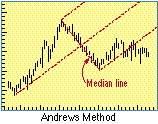
A technique whereby a technician will pick an extreme low or high to use as a pivot point and draw a line, called the median line, from this point that bisects a line drawn through the next corrective phase that occurs after the pivot point. Lines parallel to the median line are drawn through the high and low points of the corrective phase. The parallel lines define the resistance and support levels for the price channel.- Annealing (Simulated)
- Generally a metallurgical process, in artificial intelligence a process in which a neural net work searches for a set of weights to minimize errors; the search constantly shrinks as the weights find better values, analogous to the rearrangement of the molecules in a heated metal bar as the bar cools.
- Annual Earnings Change
- (%) The historical earnings change between the most recently reported fiscal year earn ings and the preceding.
- Annual Net Profit Margin
- (%) The percentage that the company earned from gross sales for the most recently reported fiscal year.
- Annual Sales Change
- (%) The percentage change in sales between the most recently reported fiscal year and the preceding.
- Annualized
- Translating the figures for a given year into an annual rate.
- Antithetic Forecasts
- Two forecasts whose errors are negatively correlated.
- Arbitrage
- The simultaneous purchase and sale of two different, but closely related, securities to take advantage of a disparity in their prices.
- ARIMA
- See AutoRegressive Integrated Moving Average
- ARMAX (AutoRegressive Moving Average eXogenous variables model)
- The combination of fundamental variables outside the particular market that correlates with the independent variable added with the ARMA modeling of the remaining residuals.
- Arms Index
- Also known as TRading INdex (TRIN):
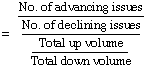
An advance/decline stock market indicator. A reading of less than 1.0 indicates bullish demand, while greater than 1.0 is bearish. The index is often smoothed with a simple moving average. - Artificial Intelligence
- The field of computer science dedicated to producing programs that attempt to mimic the processes of the human brain.
- Assign
- To transfer to another to whom property is assigned.
- Astrophysical Cycle
- Any earthly cycle, such as a market cycle, that has been scientifically related to the physics of the planetary system.
- At-the-Money
- An option whose strike price is nearest the current price of the underlying deliverable.
- Attenuation
- The fractional part of reduced energy or lost power due to smoothing or filtering.
- Autocorrelation
- The correlation between the values of a time series and previous values of the same time series.
- AutoRegressive Integrated Moving Average (ARIMA)
- A linear stochastic model forecasting methodology described by Box and Jenkins in their book Time Series Analysis, Forecasting and Control.
- Autoregressive
- Using previous data to predict future data.
- Average Directional Movement Index (ADX)
- Indicator developed by J. Welles Wilder to measure market trend intensity.
- Average True Range
- A moving average of the true range.
- %b
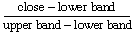
- Indicates where the closing price is within Bollinger bands:
- Back Month
- The out, or back, contract month, as opposed to the current contract month; the expiration month farther in the future than the current, or spot, month.
- Back-Propagation Network
- A feedforward multilayered neural network that is a commonly used neural network paradigm.
- Back-Testing
- A strategy is tested or optimized on historical data and then the strategy is applied to new data to see if the results are consistent.
- Balanced Mutual Fund
- A mutual fund that seeks a return that is a combination of capital appreciation and current income, generally by building a portfolio of bonds, preferred stocks and common stocks.
- Bandpass Filter
- An oscillator that accentuates only the frequencies in an intermediate range and rejects high and low frequencies. Implemented by first applying a low pass filter to the data and then a high pass filter to the resulting data (e.g., two SMA crossover system).
- Bank Investment Contracts (BICs)
- A negotiated-term deposit issued by a commercial bank. See Guaranteed Investment Contracts (GICs).
- Bar Chart
- Used to plot price movements using vertical bars indicating price ranges.
- Basis
- The difference between spot (cash) prices and the futures contract price.
- Basis Points
- The measure of yields on bonds and notes; one basis point equals 0.01% of yield.
- Basket Trades
- Large transactions made up of a number of different stocks.
- Bayes Decision Rule
- A rule that states the strategy chosen from those available is that for which the expected value of payoff is the greatest.
- Bear Market
- A securities market characterized thus based on declining prices.
- Beta
- A regression of the estimated coefficient that belongs to a particular variable.
- Beta (Coefficient)
- A measure of the market/nondiversifiable risk associated with any given security in the market. A ratio of an individual’s stock historical returns to the historical returns of the stock market. If a stock increased in value by 12% while the market increased by 10%, the stock’s beta would be 1.2.
- Bias
- The difference between the expected value of an estimator and the actual value to be estimated.
- Bid and Ask
- Highest price and lowest price that an investor will pay for a tradable.
- Bimodal Distribution
- In which observations are displayed as having two distinct peaks.
- Black Box
- A proprietary, computerized trading system whose rules are not disclosed or readily accessible.
- Black-Scholes Option Pricing Model
- A model developed to estimate the market value of option contracts.
- Block Trades
- Large transactions of a particular stock sold as a unit.
- Blow-Off Top
- A steep and rapid increase in price followed by a steep and rapid drop in price.
- Bonds
- A long-term debt security with a stated interest rate and fixed due dates, issued by a corporation or a government, when interest and principal must be paid. There are many variations.
- Boolean
- Describes a variable that may have one of only two possible values: true or false. After George Boole, English logician, credited with the invention of “Boolean logic.”
- Box-Jenkins Linear Least Squares
- The additive structure of Box-Jenkins models with a polynomial structure.
- Box-Jenkins Method
- From G.E.P. Box and G.M. Jenkins, who authored Time Series Analysis: Forecasting and Control. The method refers to the use of autoregressive integrated moving averages (ARIMA), which fit seasonal mod els and nonseasonal models to a time series.
- Box-Jenkins Nonlinear Least Squares
- The multiplicative structure of Box-Jenkins models using the Gauss-Newton algorithm with numerical derivatives.
- Bozu
- Literally “bald” or “monk” in Japanese; in candlestick terminology refers to a situation during which a trading cycle opens or closes on a high or low, indicating a victory for the bulls or the bears.
- Bracketing
- A trading range market or a price region that is non-trending.
- Breakaway Gap
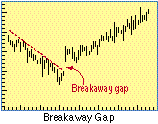
When a tradable exits a trading range by trading at price levels that leaves a price area where no trading occurs on a bar chart. Typically, these gaps appear at the completion of important chart formations.- Breakout
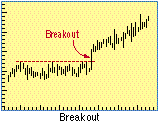
The point when the market price moves out of the trend channel.- Broker-dealer
- A firm that handles transactions for its customers and also purchases securities for its own account, selling them to customers.
- Broker’s Deck
- Orders physically held by the floor broker in the trading pit.
- Bull Market
- A securities market characterized thus on rising prices.
- Buy and Hold
- The acquisition of a tradable for the long term rather than quick turnover.
- C Language
- Widely used systems development language, also block-structured, but with more facilities to control the machine at the level of the hardware.
- Call Option
- A contract that gives the buyer of the option the right but not the obligation to take delivery of the underlying security at a specific price within a certain time.
- Calmar Ratio
- Takes the average rate of return for the last 36 months and divides it by the maximum drawdown for the same period. It is usually calculated on a monthly basis. A negative value for the Calmar ratio means that the system or trader had a negative performance over the last three years.
- Candlestick Charts
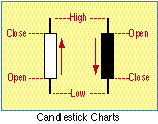
A charting method, originally from Japan, in which the high and low are plotted as a single line and are referred to as shadows. The price range between the open and the close is plotted as a narrow rectangle and is referred to as the body. If the close is above the open, the body is white. If the close is below the open, the body is black.- Capital Gains Distribution
- A distribution to investment company shareholders from net long-term capital gains realized by a regulated investment company on the sale of portfolio securities.
- Capital Losses
- Losses resulting from selling at a loss.
- CBOT
- Chicago Board of Trade.
- Central Limit Theorem
- From statistics, the theorem that the distribution of sample means taken from a large population approaches a normal, Gaussian, curve.
- Chaikin Oscillator
- An oscillator created by subtracting a 10-day EMA from a three-day EMA of the accumulation /distribution line.
- Channel
- In charting, a price channel contains prices throughout a trend. There are three basic ways to draw channels: parallel, rounded and channels that connect lows (bear trend) or highs (bull trend).
- Chaos Theory
- Describes the behavior of nonlinear systems. A subset of nonlinear dynamics analysis, chaos theory is a branch of mathematics focusing on irregular and complex behavior that has an underlying order. In the stock market, chaos theory seeks to forecast the future path of stock prices, including sudden changes that occur during periods of intense market activity.
- Charts
- A display or picture of a security that plots price and/or volume (the number of shares sold). The chart is the foundation of technical analysis, and over the years, many different types of charts have been developed.
- Chi Square
- A statistical test to determine if the patterns exhibited by data could
have been produced by chance. The chi-square test with Yates’s correction
using two-way statistics for decline vs. advance is:
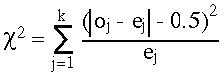
where:
oj = actual observed frequency of test
ej = expected or theoretical frequency of test. - Christmas Tree Spread
- The simultaneous purchase and writing of options with either a different strike price or expi ration date or combination of the two.
- Classifier Systems
- In artificial intelligence, these systems perform a type of machine learning that generates rules from examples.
- Clone Fund
- A smaller version of a retail mutual fund, it is offered as a subaccount in a variable annuity. The daily price of a clone fund is different among variable annuities that carry it because each clone fund starts on a different date and with a base price of $10.
- Closed-End Funds
- A mutual fund that does not sell unlimited shares; one with a specific number of outstanding shares.
- Closed Trades
- Positions that have been either liquidated or offset.
- Clustering
- Locating the presence of groups of vectors that are similar in some fashion.
- CME
- The Chicago Mercantile Exchange.
- Coefficient
- A constant used to multiply another quantity or series; as in 3 xand ax, 3 and a are coefficients ofx.
- Coefficient of Determination
- R-squared. The proportion of the variation in the data explained by the model.
- Coincidence
- In Gann theory, a projected reversal point.
- Colinear
- see Multicolinearity.
- Combined Forecast
- The weighted average of two or more forecasts.
- Commodity Futures Trading Commission (CFTC)
- A commission that oversees the commodity exchanges in the US.
- Comparative Relative Strength
- Compares the price movement of a stock with that of its competitors, industry group or the entire market. This is distinct from J. Welles Wilder’s Relative Strength Index, which compares current price movement to previous price movement of the same instrument.
- Comparitor
- A device of some kind that compares two inputs.
- Compounding
- The payment, through interest, based on the sum of the original principal amount and its accrued interest.
- Confidence Factor
- A measure of the degree of likelihood that a rule is correct, which may reflect the percentage of times that it has proven to be correct in the past or just a subjective measure of our confidence in its degree of reliability.
- Confidence Level
- The degree of assurance that a specified failure rate is not exceeded.
- Confirmation
- Indication that at least two indices, in the case of Dow theory the industrials and the transportation, corroborate a market trend or a turning point.
- Congestion Area or Pattern
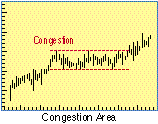
A series of trading days in which there is no visible progress in price.- Consolidation
- Also known as a congestion period. A pause that allows participants in a market to reevaluate the market and sets the stage for the next price move.
- Consumer Price Index
- The gauge of US inflation.
- Continuation Chart
- A chart in which the price scale for the data for the end of a given contract and the data for the beginning of the next contract are merged in order to ease the transition of one contract to the next.
- Contract
- An agreement as in options in which rights are exchanged by law. Correlation Coefficient-When two random variables X and Y tend to vary together. The measurement is given by the ratio of the covariance of X and Y to the square root of the product of the variance of X and the variance of Y.
- Convergence
- When futures prices and spot prices come together at the futures expiration.
- Conversion Arbitrage
- Traders buy and sell two different securities (or synthetic securities), forcing equivalent prices for equivalent securities.
- Coppock Curve
- Also Coppock Guide. A long-term price momentum indicator: a 10-month weighted moving aver age of the sum of the 14-month rate of change and the 11-month rate of change for the Djia.
- Correction
- Any price reaction within the market leading to an adjustment by as much as one-third to two-thirds of the previous gain.
- Correction Wave
- A wave or cycle of waves moving against the current impulse trend’s direction.
- Correlation Coefficient
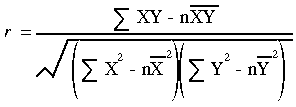
- When two random variables X and Y tend to vary together. The measurement
is given by the ratio of the covariance of X and T to the square root of
the product of the variance of X and the variance of Y.
- Correlation Coefficient
- Degree to which two series of numbers plot as a straight line. A correlation coefficient of 1 (or -1) indicates that the two series of numbers plot exactly along a straight line. A correlation coefficient of zero indicates that there is no straight line relationship between the two series of numbers. As applied to two portfolios, a high correlation coefficient for the relative returns indicates that the portfolio values have moved in tandem and a low correlation coefficient means the opposite. When the correlation coefficient is high, one portfolio could have been used as a surrogate or a hedge for the other.
- Correlogram
- A numerical and graphical display of the test statistics of an autocorrelation diagnostic routine.
- Cost Basis
- The cost of a given share or group of stock shares.
- Countermove
- A price bar showing movement opposite to the direction of the prior time period; a retracement.
- Covariance
- Multiplies the deviation of each variable from its mean, adds those products and then divides by the number of observations.
- Cover
- Purchasing back a contract sold earlier.
- Covered Write
- Writing a call against a long position in the underlying stock. By receiving a premium, the writer intends to realize additional return on the underlying common stock or gain some element of protection (limited to the amount of the premium less transaction costs) from a decline in the value of that underlying stock.
- Crack Spreads
- The spread between crude oil and its products: heating oil and unleaded gasoline plays a major role in the trading process.
- Credit Spread
- The difference in value of two options, where the value of the one sold exceeds the value of the one purchased.
- Cross Correlations
- The extent to which the revenue streams of individual traders within a single enterprise tend to exhibit similar patterns over time.
- CTI2
- Market Profile terminology for commercial clearing members, as opposed to CTI1, local floor traders.
- Cup and Handle
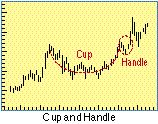
An accumulation pattern observed on bar charts. The pattern lasts from seven to 65 weeks; the cup is in the shape of a “U” and the handle is usually more than one or two weeks in duration. The handle is a slight downward drift with low trading volume from the right-hand side of the formation.- Current Ratio
- The current assets of a company divided by its current liabilities. Balance-sheet strength indication.
- Curve
- The continuous image of the unit interval.
- Curve-Fitting
- Developing complicated rules that map known conditions.
- CUSIP
- The number assigned by the Committee of Uniform Security Identification Procedure that appears on all securities documents. Each security is given a number so that it is easily identifiable.
- Cutoff Frequency
- A point where higher frequency cycles will not pass through a filter (e.g., a 10-day SMA will eliminate cycles of 20 days or less).
- Cycle
- A variation where a point of observation returns to its origin.