STOCKS & COMMODITIES magazine. The Traders' Magazine
Request Information
From Advertisers
Traders.com
Stocks &
Commodities

  • Subscribers' Area
  • Current Issue

  •    - Opening Position
       - Letters to S&C
       - Traders' Tips
       - Futures Liquidity
       - News & Products
       - Books
       - Cover Art

  • Free Articles
  • Article Abstracts
    1996-Present
  • Complete Articles
    1982-Present
  • Novice Traders' Notebook
  • Glossary
  • Subscribe
  • Renew
  • Free Trial
  • Search
  • Working
    Money
    Traders.com
    Advantage
    Traders'
    Resource
    Online Store
    Message Boards
    Article Code
    Free Newsletter
    Products
    Search
    Help
    Subscribe
    Renew
    Contact Us
     Find us on Facebook

    Products
    Small Book Image for Store.Traders.comStore.Traders.com
    Purchase past articles on hundreds of topics, along with software, books, and magazine subscriptions over a secure web connection. Click Here

     
    Search Products:

    @ Online Store!
    S&C Magazine Subscriber Login
    S&C Free Trial Issue
    S&C Volume Books
    S&C Magazine
    S&C on DVD
    Software
    Articles
    FREE ARTICLES! (while they last)
    Recognia's Kathryn St. John
    Track N Trade Live Futures
    Daytrading With Volatility
    MarketGauge Opening Range ...
    Wave59
    The 21st-Century Technician
    Trading The Pristine Method Course
    Trading The Pristine Method...Part 2
    Juggling Dynamite With Danielle Park
    Neural Network Pair Trading
    Profitunity Home Study Course
    Looking Forward With Jeff Parent
    John Wang - AbleSys Corp.
    BestChoice Software
    Window To Our Workshop
    Stock Trading Success
    eSignal 10 and Advanced GET ...
    Elwave 9.0
    VisualTrader 4.0
    Resources
    Traders' Notes
    Novice Traders
    Glossary
     
    Traders' Resource
    Advisory Services
    Books
    Brokerage
    Consultants
    Courses & Seminars
    Data Services
    Exchanges
    Hardware
    Mutual Funds
    Online Trading Services
    Publications & Newsletters
    Software
    Trading Systems

    Information Directory
    S&C Tour
    S&C Magazine
    Resources
    Products
    Subscribe
    This Month's Issue
    Home | S&C Magazine | Working Money | Traders' Resource | Message-Boards | Store


    Novice Traders Image

    Return to Topic Outline

    Other Reversal Patterns

    Diamond Formation

    The diamond formation reversal pattern is found relatively infrequently. When it does form, however, it usually does so at market tops rather than at bottoms. This is consistent with its appearance, which suggests a confused, active market found at a top more often than at a bottom. As Figure 1 shows, the diamond starts off as a broadening formation and then consolidates, usually forming a symmetrical triangle. The combination of price patterns first broadening and then consolidating gives the geometry for which the diamond is named. This shape becomes more apparent when trendlines, like those shown, are drawn connecting successive peaks and valleys. The shape has also been described as a complex head and shoulders with an odd center movement.
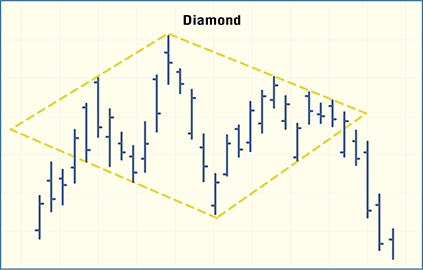
    FIGURE 1: DIAMOND FORMATIONS. This reversal pattern, which is found relatively infrequently, usually shows up at market tops rather than market bottoms. This is consistent with its appearance which suggests a confused, active market found at a top more often than at a bottom.

    Volume activity can help distinguish a diamond from an ordinary head-and-shoulders formation. The tendency might be to see a formation and interpret it as a diamond, when in reality it is only a head-and-shoulders pattern. This bias toward the diamond might be because an upsloping neckline would allow an earlier entry of the position and therefore more potential profit. A genuine diamond pattern is signified by a decrease in volume during the second half of the price pattern.

    This volume pattern is similar to the one found in a standalone symmetrical triangle. When a diamond forms at a top, the following downmove is usually significant. A minimum expectation of the move can be estimated by measuring the distance in points at the widest part of the diamond. Prices usually move from the breakout price to a low, giving a net change at least equal to this measurement, typically further.

    Return to Topic Outline or Table of Contents


    Technical Analysis, Inc.

    Bookmark and Share
    [Home | Working Money Magazine | S&C Magazine | Traders.com Advantage | Online Store]
    [Traders' Resource | Add a Product to Traders' Resource | Message Boards]
    [Subscribe/Renew | Free Trial Issue | Article Code | Search | Help Files]
    Departments: [Advertising | Editorial | Circulation | Employment | Contact Us]

    Copyright © 1996-2010 Technical Analysis, Inc. All rights reserved. Read our privacy statement.

    Technical Analysis, Inc.
    Subscribe! Free E-mail Newsletter.
    First: Last:
    E-mail: