STOCKS & COMMODITIES magazine. The Traders' Magazine
Request Information
From Advertisers
Traders.com
Stocks &
Commodities

  • Subscribers' Area
  • Current Issue

  •    - Opening Position
       - Letters to S&C
       - Traders' Tips
       - Futures Liquidity
       - News & Products
       - Books
       - Cover Art

  • Free Articles
  • Article Abstracts
    1996-Present
  • Complete Articles
    1982-Present
  • Novice Traders' Notebook
  • Glossary
  • Subscribe
  • Renew
  • Free Trial
  • Search
  • Working
    Money
    Traders.com
    Advantage
    Traders'
    Resource
    Online Store
    Message Boards
    Article Code
    Free Newsletter
    Products
    Search
    Help
    Subscribe
    Renew
    Contact Us
    Home

    Products
    Small Book Image for Store.Traders.comStore.Traders.com
    Purchase past articles on hundreds of topics, along with software, books, and magazine subscriptions over a secure web connection. Click Here

     
    Search Products:

    @ Online Store!
    S&C Magazine Subscriber Login
    S&C Free Trial Issue
    S&C Volume Books
    S&C Magazine
    S&C on DVD
    Software
    Articles
    FREE ARTICLES! (while they last)
    MarketGauge Opening Range ...
    Wave59
    The 21st-Century Technician
    Trading The Pristine Method Course
    Trading The Pristine Method...Part 2
    Juggling Dynamite With Danielle Park
    Neural Network Pair Trading
    Profitunity Home Study Course
    Looking Forward With Jeff Parent
    John Wang - AbleSys Corp.
    BestChoice Software
    Window To Our Workshop
    Stock Trading Success
    The Danger Zone With ...
    Track N Trade Live Futures
    eSignal 10 and Advanced GET ...
    Elwave 9.0
    VisualTrader 4.0
    FXEducator's Ed Ponsi
    CrimsonMind.com
    Traders' Resource
    Advisory Services
    Books
    Brokerage
    Consultants
    Courses & Seminars
    Data Services
    Exchanges
    Hardware
    Mutual Funds
    Online Trading Services
    Publications & Newsletters
    Software
    Trading Systems

    Information Directory
    S&C Tour
    S&C Magazine
    Resources
    Products
    Subscribe
    This Month's Issue
    Home | S&C Magazine | Working Money | Traders' Resource | Message-Boards | Store

    TRADING SYSTEMS

    Too Far, Too Fast

    Making The Most Of A Trend
    With The Disparity Index

    by Dan Valcu

    In volatile markets, it’s difficult to forecast the formation of peaks and troughs. The disparity index is an indicator that helps you squeeze the best out of a trend whether you are trading equities, futures, or forex.

    Prices often rise or fall rapidly in a short period of time. But what is considered too far and too fast? How can we quantify these terms? Many techniques and indicators are used already to deal with this task, among them trendline slopes, breakouts, up and down gaps, and oscillators (rate of change, moving average convergence/divergence [Macd]).

    In these fast rises and falls, it is only natural and normal to miss the peaks and troughs. At any given time, there is at least one market and several sectors and stocks that display excess. Is there an indicator that can improve your entries and exits? In this article I describe a simple indicator called the disparity index (Dix) and its use in warning about the formation of possible peaks and troughs in volatile market conditions. The Dix can best be used in situations when prices rise or decline rapidly in a short period of time.

    Disparity index
    How many times have you given back the market too much of your gains? If it happens more often than not, the disparity index is for you. The index is a simple statistical measure of price deviation from a mean. It is used as a tool, together with other indicators, for fine-tuning your trades.

    If you stretch a coil, the more you pull at both ends the greater the danger of it snapping. However, when released, the coil returns to its initial position. A rubber band and, to some extent, a pendulum display similar behavior. After being stretched or swung, both return to a neutral state before going the other direction. Asset prices behave in a similar way; the more they deviate from a reference value, the greater the probability is to return to the original level or even exceed it. Simply, it is a reversal to the mean.
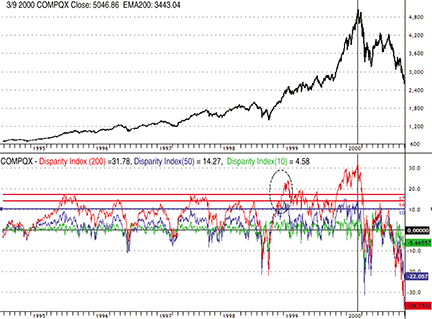
    Image 1

    Figure 1: NASDAQ COMPOSITE INDEX AND DIX. The disparity indexes for 50 and 200 days are shooting off above consensus and issue a warning in late 1998.

    Let’s start with the Nasdaq Composite Index (daily chart in Figure 1). From the price chart on the top pane, you can see how the Nasdaq evolved before reaching its peak in 2000. In 1999, the index was subject to different opinions: some said that the Nasdaq was not overvalued, while others warned that the traders should get out of that market as soon as possible. As always, the lack of a measurement tool led to misinterpretations. The disparity index introduces that much-needed objectivity in situations where things are or look abnormal (for example, rapid price rises or declines during short periods of time).

    ...Continued in the December issue of Technical Analysis of Stocks & Commodities

    Return to Contents

    Technical Analysis, Inc.

    Bookmark and Share
    [Home | Working Money Magazine | S&C Magazine | Traders.com Advantage | Online Store]
    [Traders' Resource | Add a Product to Traders' Resource | Message Boards]
    [Subscribe/Renew | Free Trial Issue | Article Code | Search | Help Files]
    Departments: [Advertising | Editorial | Circulation | Employment | Contact Us]

    Copyright © 1996-2010 Technical Analysis, Inc. All rights reserved. Read our privacy statement.

    Technical Analysis, Inc.
    Subscribe! Free E-mail Newsletter.
    First: Last:
    E-mail: