STOCKS & COMMODITIES magazine. The Traders' Magazine
Request Information
From Advertisers
Traders.com
Stocks &
Commodities

  • Subscribers' Area
  • Current Issue

  •    - Opening Position
       - Letters to S&C
       - Traders' Tips
       - Futures Liquidity
       - News & Products
       - Books
       - Cover Art

  • Free Articles
  • Article Abstracts
    1996-Present
  • Complete Articles
    1982-Present
  • Novice Traders' Notebook
  • Glossary
  • Subscribe
  • Renew
  • Free Trial
  • Search
  • Working
    Money
    Traders.com
    Advantage
    Traders'
    Resource
    Online Store
    Message Boards
    Article Code
    Free Newsletter
    Products
    Search
    Help
    Subscribe
    Renew
    Contact Us
     Find us on Facebook

    Products
    Small Book Image for Store.Traders.comStore.Traders.com
    Purchase past articles on hundreds of topics, along with software, books, and magazine subscriptions over a secure web connection. Click Here

     
    Search Products:

    @ Online Store!
    S&C Magazine Subscriber Login
    S&C Free Trial Issue
    S&C Volume Books
    S&C Magazine
    S&C on DVD
    Software
    Articles
    FREE ARTICLES! (while they last)
    Recognia's Kathryn St. John
    Track N Trade Live Futures
    Daytrading With Volatility
    MarketGauge Opening Range ...
    Wave59
    The 21st-Century Technician
    Trading The Pristine Method Course
    Trading The Pristine Method...Part 2
    Juggling Dynamite With Danielle Park
    Neural Network Pair Trading
    Profitunity Home Study Course
    Looking Forward With Jeff Parent
    John Wang - AbleSys Corp.
    BestChoice Software
    Window To Our Workshop
    Stock Trading Success
    eSignal 10 and Advanced GET ...
    Elwave 9.0
    VisualTrader 4.0
    Traders' Resource
    Advisory Services
    Books
    Brokerage
    Consultants
    Courses & Seminars
    Data Services
    Exchanges
    Hardware
    Mutual Funds
    Online Trading Services
    Publications & Newsletters
    Software
    Trading Systems

    Information Directory
    S&C Tour
    S&C Magazine
    Resources
    Products
    Subscribe
    This Month's Issue
    Home | S&C Magazine | Working Money | Traders' Resource | Message-Boards | Store

    CHART PATTERNS

    Understanding Market Data

    Crude Oil And Candlesticks

    by Gary S. Wagner

    The rise and fall of oil prices have a global effect on all aspects of the markets. Here we look at this historical price movement through the eyes of candle patterns.

    The underlying psychology of market sentiment is a complex structure. It is difficult to understand and more difficult to explain. Fundamental analysis can be best expressed through words, interpreting how new information might bring about change in market price, while technical analysis uses mathematics to explain price movement. All market analysts distill information from which they formulate their assumptions. The master market technicians will use a mixture of both for successful trading.

    What we call Japanese candlestick charts and patterns are the results of a trading system created hundreds of years ago and refined into its current form. The Japanese technician was one of the first to describe market sentiment as a battle between the bulls and bears. The outcome of the battle can be mathematically expressed as a single candlestick.

    Trader’s attitude
    The candlestick technique teaches us to identify the trader’s attitude about the market. It is one of our earliest attempts to explain how traders believe a market will act. These patterns are the culmination of the original concept that over time were turned into identifiable patterns. By learning to identify these patterns, you can discover a systematic approach to recognizing both trends and reversals of the price of any stock or commodity.

    The formations identified in candlestick patterns are based upon the sakata method, derived from the 160 rules that Sokyu Honma, credited to be the developer of the candlestick technique, created to guide his trading, as revealed in his work, The Fountain Of Gold: The Three-Monkey Record Of Money. He suggested that traders’ emotions have a considerable influence on price. This is where he suggested using the characteristics of the famous three monkeys:

    • See no evil. When you see a trend, do not assume the continuation of its direction; it could be an opportunity for a reversal.
    • Hear no evil. When you hear news, do not trade on it.
    • Speak no evil. Do not discuss what you are about to do in the market.

    It is from this work that candlestick charting and their patterns originate. Honma first wrote of the sakata five-method, five pattern groups based on the number three: Three mountains, three rivers, three gaps, three soldiers, and the three method. Over time these concepts evolved into the candlestick patterns taught to traders today.
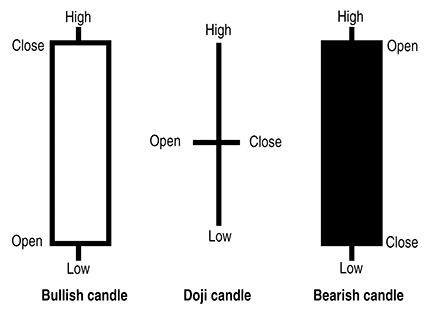
    Image 1

    Figure 1: long sessions. The range between the opening and closing prices is larger than in the preceding five to 10 days.

    ...Continued in the January issue of Technical Analysis of Stocks & Commodities

    Return to Contents

    Technical Analysis, Inc.

    Bookmark and Share
    [Home | Working Money Magazine | S&C Magazine | Traders.com Advantage | Online Store]
    [Traders' Resource | Add a Product to Traders' Resource | Message Boards]
    [Subscribe/Renew | Free Trial Issue | Article Code | Search | Help Files]
    Departments: [Advertising | Editorial | Circulation | Employment | Contact Us]

    Copyright © 1996-2010 Technical Analysis, Inc. All rights reserved. Read our privacy statement.

    Technical Analysis, Inc.
    Subscribe! Free E-mail Newsletter.
    First: Last:
    E-mail: