STOCKS & COMMODITIES magazine. The Traders' Magazine
Request Information
From Advertisers
Traders.com
Stocks &
Commodities

  • Subscribers' Area
  • Current Issue

  •    - Opening Position
       - Letters to S&C
       - Traders' Tips
       - Futures Liquidity
       - News & Products
       - Books
       - Cover Art

  • Free Articles
  • Article Abstracts
    1996-Present
  • Complete Articles
    1982-Present
  • Novice Traders' Notebook
  • Glossary
  • Subscribe
  • Renew
  • Free Trial
  • Search
  • Working
    Money
    Traders.com
    Advantage
    Traders'
    Resource
    Online Store
    Message Boards
    Article Code
    Free Newsletter
    Products
    Search
    Help
    Subscribe
    Renew
    Contact Us
     Find us on Facebook

    Products
    Small Book Image for Store.Traders.comStore.Traders.com
    Purchase past articles on hundreds of topics, along with software, books, and magazine subscriptions over a secure web connection. Click Here

     
    Search Products:

    @ Online Store!
    S&C Magazine Subscriber Login
    S&C Free Trial Issue
    S&C Volume Books
    S&C Magazine
    S&C on DVD
    Software
    Articles
    FREE ARTICLES! (while they last)
    Recognia's Kathryn St. John
    Track N Trade Live Futures
    Daytrading With Volatility
    MarketGauge Opening Range ...
    Wave59
    The 21st-Century Technician
    Trading The Pristine Method Course
    Trading The Pristine Method...Part 2
    Juggling Dynamite With Danielle Park
    Neural Network Pair Trading
    Profitunity Home Study Course
    Looking Forward With Jeff Parent
    John Wang - AbleSys Corp.
    BestChoice Software
    Window To Our Workshop
    Stock Trading Success
    eSignal 10 and Advanced GET ...
    Elwave 9.0
    VisualTrader 4.0
    Traders' Resource
    Advisory Services
    Books
    Brokerage
    Consultants
    Courses & Seminars
    Data Services
    Exchanges
    Hardware
    Mutual Funds
    Online Trading Services
    Publications & Newsletters
    Software
    Trading Systems

    Information Directory
    S&C Tour
    S&C Magazine
    Resources
    Products
    Subscribe
    This Month's Issue
    Home | S&C Magazine | Working Money | Traders' Resource | Message-Boards | Store

    CHARTING

    Is It Harder To Make Money These Days?

    Do Chart Patterns Still Work?

    by Thomas Bulkowski

    Has the failure rate of chart patterns increased in recent years?

    In the last several years, have you found it more difficult to make money in the stock market? Do you get the feeling that indicators are less effective than they used to be in spotting profitable opportunities? I decided to find the answers to those questions with a new study. I spent a week updating a database of chart patterns that I used during research for writing my books, and found an alarming result.

    In my investigation, I used 13,932 chart patterns spread over the years from 1991 to 2008. I did not use all of the chart pattern types in my analysis but concentrated on 23 of the most common and popular. They are: diamond tops and bottoms; double tops and bottoms (eight types of Adam and Eve combinations); triple tops and bottoms; rising and falling wedges; head & shoulders tops and bottoms (four types of simple and complex); ascending, descending, and symmetrical triangles; and rectangle tops and bottoms.

    Excluded were broadening patterns (six types) and scallops (four types) because of the difficulty in determining where the breakout is. Horns and pipes also did not make the cut because they perform best on the weekly scale. I only tested chart patterns using daily price data. The plethora of patterns means that when separated into years, there were an average of 425 samples per year, and I wanted to keep the sample counts as high as possible for a statistically meaningful result.
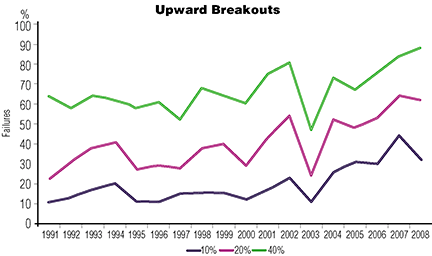
    Image 1

    Figure 1: upward breakouts. Here you see three failure rates from chart patterns with upward breakouts. Note the upward trend over the years. Failures in 1991 were a third of what they were in 2007. Trading chart patterns and making a profit has become substantially more difficult.

    Upward breakouts
    I split the data into two types of patterns, those with upward breakouts and those with downward ones. Figure 1 shows three failure rates from chart patterns with upward breakouts.

    I calculated the rise using the closing price from the day before the breakout (to include breakout day gaps) to the ultimate high, which is the highest peak before price dropped by at least 20% (signifying a trend change), or closed below the bottom of the chart pattern. Then I counted the number of patterns that failed to show post-breakout rises of 10%, 20%, and 40% before the trend changed.

    ...Continued in the May issue of Technical Analysis of Stocks & Commodities

    Return to Contents

    Technical Analysis, Inc.

    Bookmark and Share
    [Home | Working Money Magazine | S&C Magazine | Traders.com Advantage | Online Store]
    [Traders' Resource | Add a Product to Traders' Resource | Message Boards]
    [Subscribe/Renew | Free Trial Issue | Article Code | Search | Help Files]
    Departments: [Advertising | Editorial | Circulation | Employment | Contact Us]

    Copyright © 1996-2010 Technical Analysis, Inc. All rights reserved. Read our privacy statement.

    Technical Analysis, Inc.
    Subscribe! Free E-mail Newsletter.
    First: Last:
    E-mail: